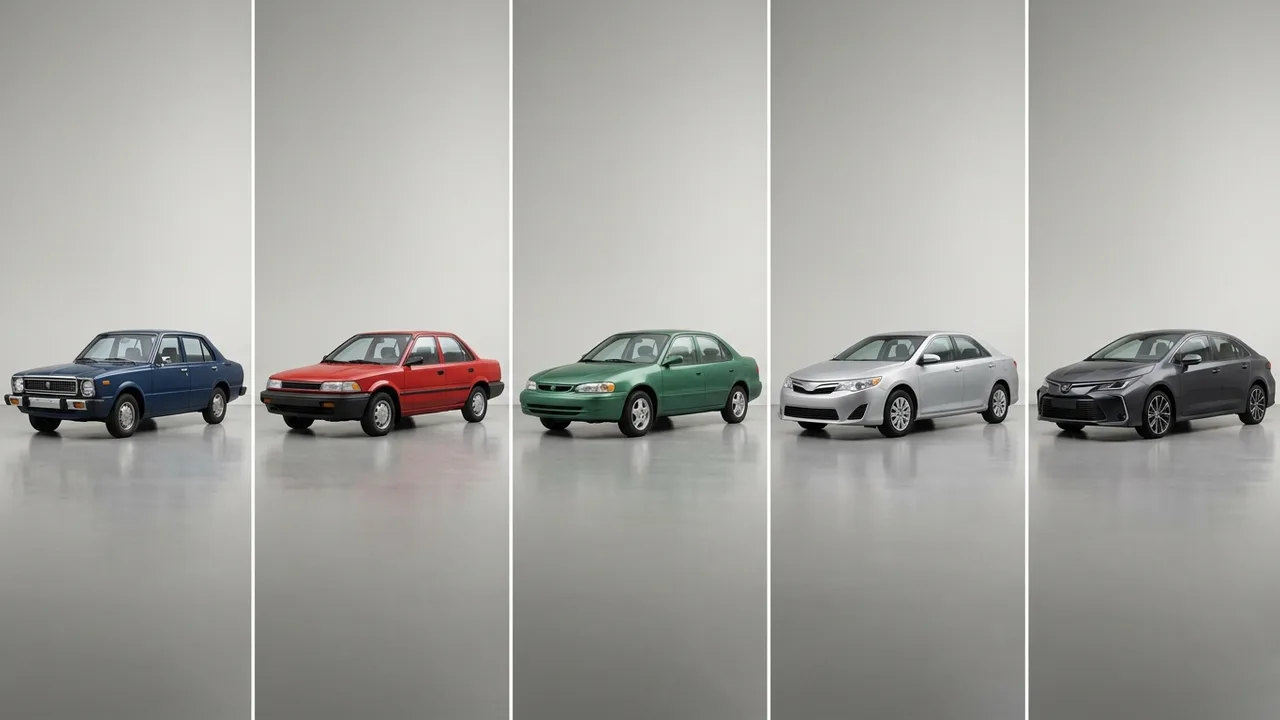
📚 MODEL CHRONOLOGY. Generation details drawn from Toyota records and established sources. Corolla generations differ by region.
Why the Corolla matters
The Corolla is the best-selling nameplate in automotive history, with cumulative sales measured in the tens of millions across roughly six decades and twelve generations.
That longevity is the interesting part. Countless nameplates have been more exciting, more advanced or more admired. Almost none survived, and understanding why the Corolla did tells you more about the car industry than any performance figure.
The philosophy that never changed
Across every generation, the brief has been remarkably consistent: sensible, affordable, reliable transport for ordinary people, built to a standard that doesn't disappoint.
Toyota has resisted, repeatedly, the temptation to make it something else. It has not chased sportiness, or luxury, or fashion. When it has flirted with those things, it has done so in variants rather than by moving the core product.
That discipline is rarer than it sounds, and it's the single biggest reason the nameplate endures.
The generations, in outline
Regional variations are substantial — verify specifics for your market:
First generation (from 1966). Launched as a small, conventional saloon aimed at Japan's emerging mass market. Modest, competent, and immediately successful.
Second and third generations (1970s). Expansion into global markets, particularly North America, where the oil crises of the decade created enormous demand for efficient small cars. The Corolla was in exactly the right place at the right time, and the reputation built here proved durable.
Fourth and fifth generations (late 1970s–1980s). Growing sophistication, wider body-style range, and the transition to front-wheel drive across most of the range — a fundamental architectural shift. The rear-drive AE86 variant of this era became a cult icon precisely because it was the exception.
Sixth and seventh generations (late 1980s–1990s). Increasingly refined and better built, consolidating the reliability reputation that became the nameplate's defining asset.
Eighth and ninth generations (late 1990s–2000s). The 1998 car our then-and-now comparison examined sits here — a period of peak simplicity, when a Corolla was light, straightforward and owner-serviceable.
Tenth and eleventh generations (2000s–2010s). Growth in size, equipment and safety content, following the industry-wide pattern our Corolla comparison documented: substantially safer and better equipped, and substantially heavier.
Twelfth generation (from 2018) and current. Built on the TNGA platform, with hybrid powertrains becoming central rather than optional. Better to drive than its predecessors — a genuine and somewhat overdue improvement — while retaining the sensible core.
What the chronology reveals
1. Consistency beat brilliance. The Corolla was rarely the best car in its class. It was reliably good, for sixty years, which turned out to matter more.
2. The reliability reputation is the product. It was earned in the 1970s and 80s and has been protected since. As our comparisons repeatedly find, Toyota's resale strength is real money — and resale strength is reputation converted to currency.
3. It got heavier, like everything. As our then-and-now analysis found, the modern car is incomparably safer, more efficient and better equipped — and substantially heavier and less repairable. Both halves are true.
4. Hybridisation was the right bet. Toyota's early and sustained hybrid investment looks increasingly astute. As our family sedan comparison found, making the Camry hybrid-only gave the entire range class-leading efficiency — and the same logic applies here.
5. It survived the SUV shift by adding crossover variants rather than abandoning the nameplate — a lesson several competitors learned expensively.
The bottom line
The Corolla is the best-selling car in history because Toyota decided what it was for and then didn't change its mind for sixty years.
It was rarely exciting and never fashionable. It was reliably good, sensibly priced, cheap to run and expensive to argue with — and every generation protected the reputation the previous one built.
The chronology's real lesson is about discipline. Dozens of nameplates chased trends, moved upmarket, or tried to become something more interesting. Most are gone.
The Corolla stayed a Corolla, and outlasted almost all of them.
Key takeaways
- The best-selling nameplate in history across roughly six decades and twelve generations — and the longevity is the interesting part
- The brief never changed: sensible, affordable, reliable transport built to a standard that doesn't disappoint — and Toyota resisted making it something else
- The reliability reputation, earned in the 1970s–80s, is the actual product — and resale strength is that reputation converted to currency
- Like everything, it got substantially safer and heavier, and considerably less owner-serviceable
- The real lesson is discipline: dozens of nameplates chased trends and are gone. The Corolla stayed a Corolla
Sources & further reading
- Toyota historical records
Figures, prices and policy details were current at the last-updated date above. Automotive pricing, incentives and regulations change frequently — verify time-sensitive details against the primary sources listed below. Read our editorial policy and fact-checking standards.