📚 MODEL CHRONOLOGY. Details drawn from Mahindra records and established sources.
From licence-built utility to object of desire
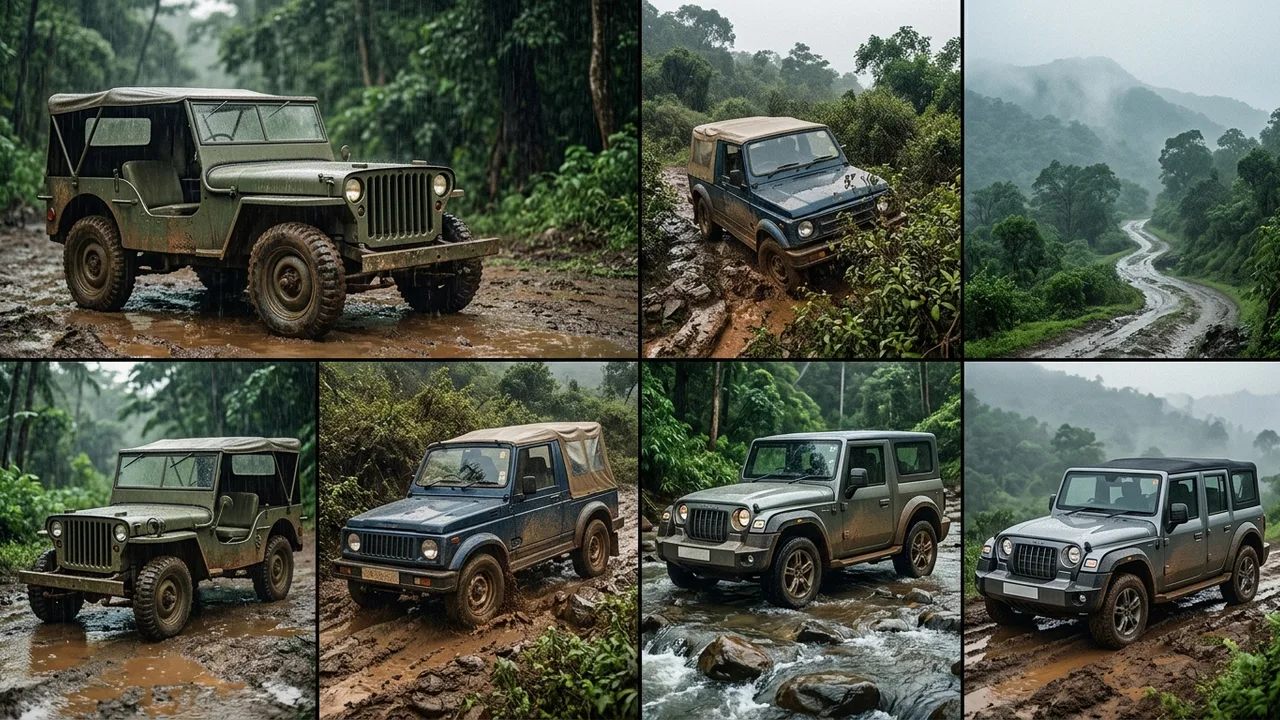
The Thar's lineage begins with the Willys Jeep.
Mahindra began assembling and later manufacturing Willys CJ-series vehicles under licence in the post-independence period — a genuinely significant industrial undertaking for a young Indian manufacturing sector, and one that established Mahindra's identity around rugged, utilitarian, capable vehicles.
That inheritance is the foundation, and everything the Thar became is built on it.
The lineage
Willys CJ (licence production, from the 1940s–50s). Rugged, simple, genuinely capable four-wheel drive — the archetype the entire segment descends from. Used extensively by military, agricultural and government operators, establishing durability credentials that carried forward for decades.
Mahindra CJ series and derivatives (through the following decades). Progressive Indianisation of the design, with locally-developed engines and adaptations for Indian conditions and requirements. These were working vehicles, bought for capability rather than character.
Mahindra MM540 / MM550 and Major (1980s–2000s). Continued development of the utilitarian formula, serving rural, agricultural, military and commercial users. Still emphatically tools.
Mahindra Thar (from 2010). The name arrives, and with it a subtle but significant repositioning. Still genuinely capable and still fundamentally utilitarian — but beginning to be bought by people who wanted it rather than needed it.
Second-generation Thar (from 2020) — the transformation. This is the decisive moment.
The 2020 Thar was substantially more refined, better equipped, considerably safer and far more liveable, while retaining genuine off-road capability. It became a phenomenon. Waiting lists stretched for months, and it achieved something no previous Mahindra utility vehicle had: it became aspirational.
As our Thar review put it, it had turned "a utilitarian military-derived off-roader into an aspirational lifestyle statement."
Thar Roxx (from 2024). The five-door variant, addressing the three-door's fundamental practicality limitation and bringing the formula to families who wanted the character without the compromise.
Thar facelift (current). As our first drive found, the update is "sharper, safer, still a Thar" — improved safety and refinement, with the raw character deliberately preserved. Mahindra understood that the character is the product.
Why the 2020 car changed everything
Three things converged:
1. It became genuinely liveable without losing capability. Previous generations demanded real sacrifice; the 2020 car reduced that substantially while keeping the hardware honest.
2. Cultural presence. As our Bollywood feature explored, the Thar acquired meaning — adventure, independence, confident modernity — through screen presence and social media visibility. That meaning wasn't bought; it accumulated.
3. It arrived as India's aspirations shifted. A growing, wealthier middle class wanted vehicles that signified lifestyle rather than merely function. The Thar was perfectly positioned, almost by accident.
What the chronology reveals
1. Authenticity can't be manufactured, but it can be inherited. The Thar's credibility comes from decades of genuine utility work. A styling exercise couldn't replicate it, which is why competitors struggle.
2. The facelift's challenge was delicate, and our review flagged exactly why: refine the rough edges that genuinely needed refining, without touching the raw character that made it a phenomenon. The character is the product, and diluting it would have been the obvious mistake.
3. Practicality was the real limitation, and the Roxx answered it — which is why we recommend it for families in our coverage.
4. Safety improvement was overdue and welcome. As our micro-SUV comparison argued, Indian buyers shouldn't trade crash protection for savings — and a vehicle bought increasingly as a family lifestyle purchase needed to meet that standard.
The bottom line
The Thar's story runs from licence-built Willys Jeeps — genuinely significant early Indian manufacturing — through decades of utilitarian service to a cultural phenomenon that Indians wait months to buy.
The transformation happened in 2020, when the vehicle became liveable enough to want without losing the capability that made it credible.
Its authenticity is inherited rather than designed, which is precisely why it's difficult for rivals to replicate — you cannot manufacture seventy years of genuine utility work.
And the facelift got the hardest part right: refining what needed refining while leaving the character alone. For a vehicle whose appeal is its character, that restraint was the whole job.
Key takeaways
- The lineage begins with licence-built Willys Jeeps — genuinely significant early Indian manufacturing, and the source of the Thar's inherited credibility
- Decades of utilitarian military, agricultural and government service built durability credentials no styling exercise could replicate
- The 2020 second generation was the transformation: liveable enough to want, capable enough to be credible, and it became a phenomenon
- Cultural presence did the rest — as our Bollywood feature found, the meaning accumulated rather than being bought
- The facelift's job was delicate and it succeeded: refine what needed refining, leave the character alone. The character is the product
Sources & further reading
- Mahindra historical records
Figures, prices and policy details were current at the last-updated date above. Automotive pricing, incentives and regulations change frequently — verify time-sensitive details against the primary sources listed below. Read our editorial policy and fact-checking standards.