📚 MODEL CHRONOLOGY. Details drawn from Ford records and established sources.
The default American vehicle
The Ford F-Series has been America's best-selling vehicle for decades, and the best-selling truck for longer still. It is, by most measures, the most commercially significant vehicle line in the American market.
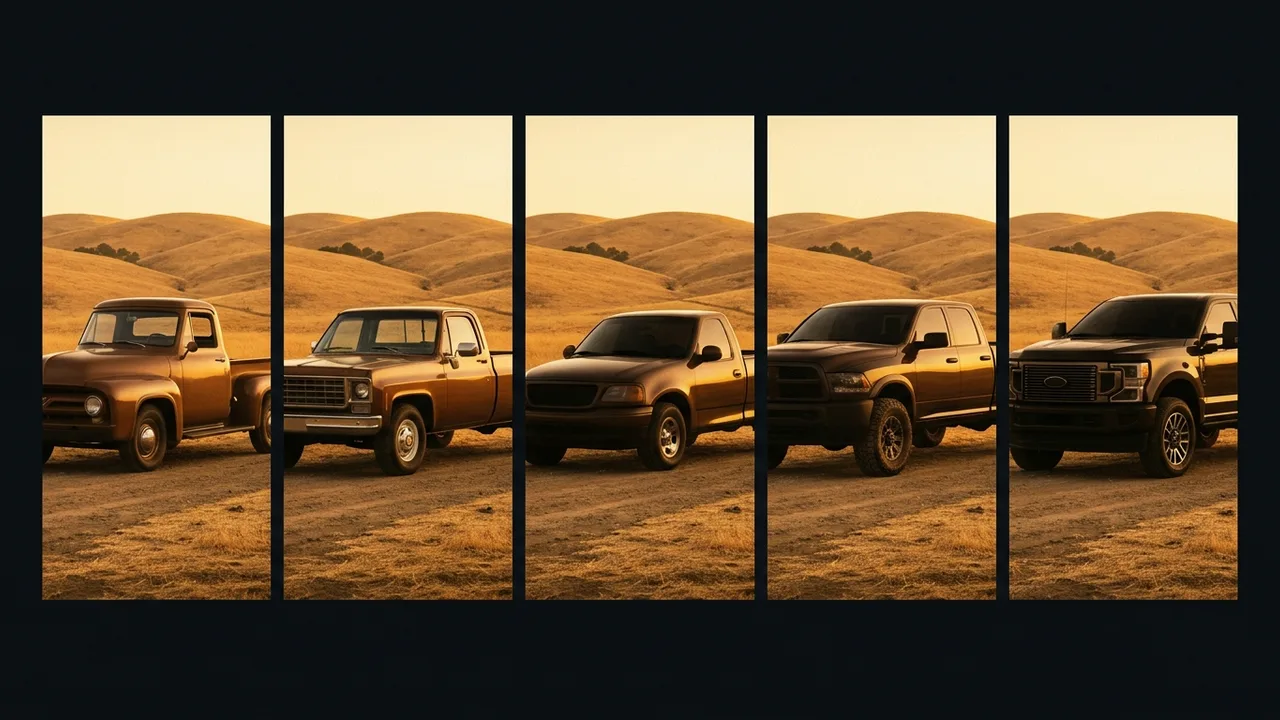
The chronology matters because it tracks the country. The F-Series began as a work tool and became — without ever ceasing to be a work tool — a luxury product, a family vehicle and a cultural fixture.
The generations, in outline
First generation, "Bonus Built" (1948–1952). The post-war debut, and the first purpose-designed Ford truck rather than a car-derived one. Utilitarian, straightforward, aimed squarely at work.
Second through fifth generations (1953–1979). Steady growth in capability, comfort and range. The F-100/F-150/F-250 naming establishes itself, and the truck begins its slow transition from purely commercial to dual-purpose. The F-150 designation arrives in 1975, positioned between the F-100 and F-250 partly for regulatory reasons.
Sixth through eighth generations (1980–1996). The truck becomes genuinely mainstream. Crew cabs, better interiors and improved refinement widen the audience beyond trades, and the F-Series' position as America's best-seller consolidates.
Ninth and tenth generations (1997–2003). Significant modernisation — more car-like ergonomics, better safety, and a broader trim range extending upward into genuine comfort.
Eleventh and twelfth generations (2004–2014). Continued growth in size, capability and luxury. The upper trims move decisively into premium territory, establishing the luxury-truck category that now represents a substantial share of the market.
Thirteenth generation (2015–2020) — the aluminium decision. The most consequential engineering choice in the line's modern history: an aluminium-alloy body, saving substantial weight and improving efficiency and payload.
It was a genuine risk. Aluminium repair required different equipment and training, and the durability question was aggressively contested by competitors. It worked, and it remains the boldest bet in the segment.
Fourteenth generation (2021–present). Further refinement, plus the two developments that define the current era: the PowerBoost hybrid — which our truck comparison placed first, partly on economy and partly on its Pro Power Onboard generator — and the F-150 Lightning, the battery-electric variant.
The two decisions that mattered most
1. Aluminium. Reducing weight in a segment where weight had only ever increased was genuinely counterintuitive, and it directly improved payload, towing and efficiency simultaneously. As our testing repeatedly finds, mass punishes everything — and this is one of the few cases where a mainstream manufacturer went the other way at scale.
2. Pro Power Onboard. Our truck comparison placed the F-150 PowerBoost first substantially because of it. The ability to function as a mobile generator — powering tools on site, a home during an outage, a campsite — changes what a truck can do, and for tradespeople it can replace a separate generator entirely.
It's the rare feature that adds genuine capability rather than convenience.
What the chronology reveals
1. The truck followed America. From work tool to family vehicle to luxury product, the F-Series' evolution tracks how Americans lived and what they could afford.
2. Breadth is the strategy. As our comparison found, the range spans work trucks to luxury trims to the Lightning EV — meaning most buyers find a version that fits precisely. That breadth is difficult to replicate.
3. Electrification is proceeding unevenly, and Ford hedged well. The Lightning exists; pure-electric pickup demand undershot forecasts significantly. Ford's simultaneous investment in the PowerBoost hybrid looks increasingly astute — as does GM's conventional-V8 hedge and Ram's pivot to the Ramcharger EREV.
4. The V8 endures, for the practical reasons our Silverado coverage set out: towing without range collapse, universal refuelling, proven durability and genuine buyer demand.
The bottom line
The F-Series became America's default vehicle by following the country rather than leading it — from post-war work tool to family vehicle to luxury product, while never abandoning the capability that justified it.
The two decisions that mattered most were both counterintuitive: an aluminium body that reduced weight in a segment that only ever grew, and an onboard generator that added genuine capability rather than comfort.
Its current position reflects a well-hedged transition. The Lightning exists for buyers who want it; the PowerBoost hybrid won our comparison; and the conventional V8 continues for the practical reasons that were never sentimental.
Seventy-eight years in, the strategy is the same one it started with: build what people actually need to do work, and let the rest follow.
Key takeaways
- America's best-selling vehicle for decades across fourteen generations — the chronology tracks the country itself
- The transition from work tool to family vehicle to luxury product happened without abandoning the capability that justified it
- The aluminium body (2015) was the boldest bet in the segment — reducing weight where weight had only ever increased, improving payload, towing and efficiency at once
- Pro Power Onboard adds genuine capability rather than convenience — it's why our truck comparison placed the PowerBoost hybrid first
- Ford hedged the transition well: the Lightning exists, the hybrid won our comparison, and the V8 endures for practical reasons
Sources & further reading
- Ford historical records
Figures, prices and policy details were current at the last-updated date above. Automotive pricing, incentives and regulations change frequently — verify time-sensitive details against the primary sources listed below. Read our editorial policy and fact-checking standards.