📚 MOMENTS & MILESTONES. This article concerns injury prevention. It is written to be useful rather than distressing, and contains no descriptions of injury.
The idea that seems wrong
For most of motoring's first half-century, a strong car was assumed to be a safe car. Build it rigidly, and occupants are protected.
That intuition is exactly backwards, and correcting it is the single most important development in automotive safety.
The insight — credited principally to Béla Barényi at Mercedes-Benz, with patents from the 1950s — is that the car should deliberately destroy itself in a controlled way.
Why deforming beats resisting
The physics is straightforward once stated.
In a crash, the occupant's body must decelerate from travelling speed to zero. The injury is caused by the rate of that deceleration, not by the impact itself.
A rigid car stops almost instantly, transferring that abrupt deceleration directly to the occupants.
A car with crumple zones deforms progressively, extending the deceleration over a longer time and distance. Even a small extension dramatically reduces the forces reaching the occupant.
So the design principle is: a rigid safety cell around the occupants, surrounded by deliberately deformable structures front and rear that absorb energy by destroying themselves.
The car is sacrificed to protect the person, which is why a modern car looks catastrophically damaged after a crash its occupants walk away from. That damage is the system working.
The developments that followed
Crumple zones and the safety cell established the architecture, and everything since builds on it:
The three-point seatbelt. Developed by Nils Bohlin at Volvo (1959) — and, significantly, Volvo made the patent freely available so the industry could adopt it. It is among the most consequential decisions any manufacturer has made.
As our India road safety investigation documented, 16,025 people died in 2023 alone for not wearing one. The technology works; the usage doesn't always follow.
Collapsible steering columns, preventing the column acting as a spear in a frontal impact.
Laminated windscreens and safety glass.
Airbags, as a supplementary restraint working with — not instead of — belts.
Side-impact protection, then side and curtain airbags.
Electronic stability control, which is arguably the most significant single safety advance after belts, because it prevents crashes rather than surviving them.
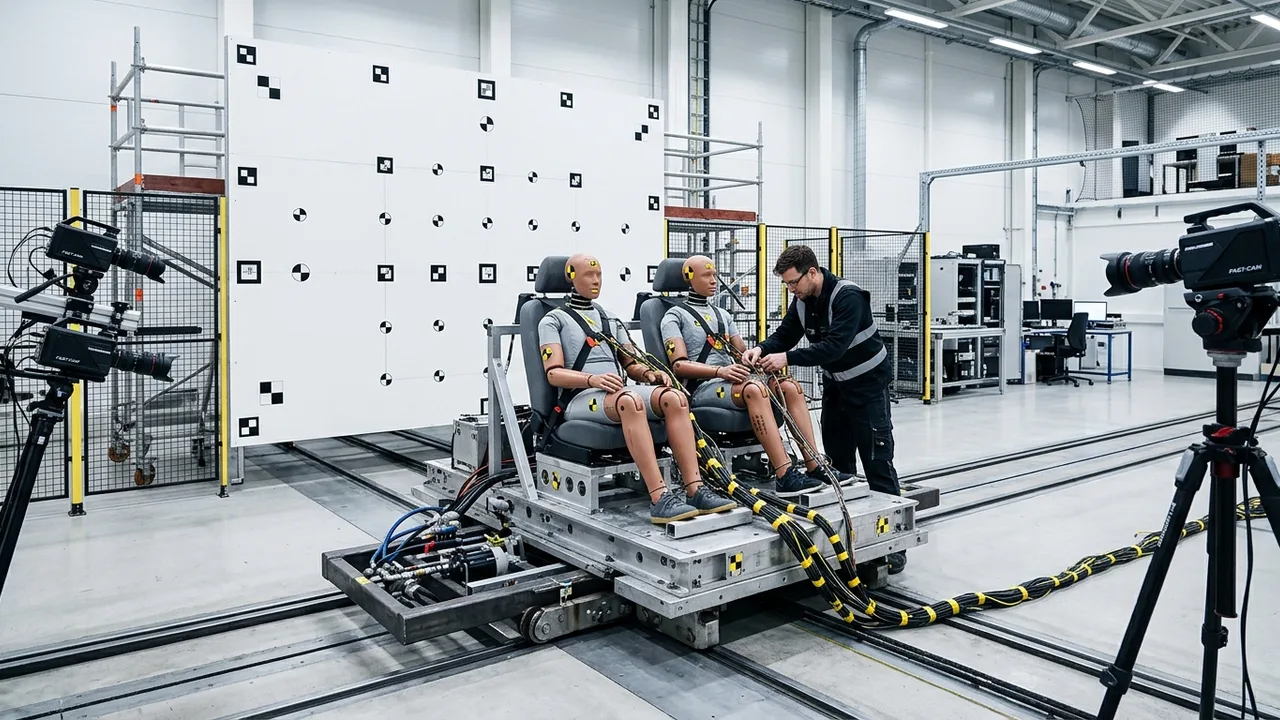
Independent crash testing. NCAP programmes worldwide made safety visible and comparable, which changed manufacturer behaviour more effectively than regulation alone.
Automatic emergency braking, which — as our Learner's Permit column noted from experience — intervenes faster than a human can.
The shift from surviving to avoiding
This is the most important recent development, and it deserves emphasis.
Passive safety — crumple zones, belts, airbags — protects you during a crash.
Active safety — stability control, AEB, lane keeping — prevents the crash from happening.
The second is better, obviously, and the industry's focus has shifted accordingly.
As our Corolla then-and-now analysis concluded, active systems represent a genuine step-change in real-world outcomes: a modern car doesn't just protect its occupants better, it avoids collisions the older one would have had.
What made it happen
Three forces, and the third is the interesting one:
1. Regulation. Minimum standards forced adoption of belts, structures and eventually electronic aids.
2. Engineering. Barényi, Bohlin and thousands of others.
3. ⭐ Visibility.
This is the underrated factor, and it's the argument our Bharat NCAP coverage makes.
Independent crash testing made safety comparable and public. A star rating a buyer can see changes purchasing behaviour, and purchasing behaviour changes manufacturer behaviour faster than regulation alone.
The Indian evidence is the clearest available. As our micro-SUV comparison found, the Tata Punch's 5-star Global NCAP rating at an accessible price proved crash protection needn't be a premium feature — and it took the best-selling car title partly on that basis.
That's competition improving safety, and it happened because ratings made the difference visible.
What remains
1. Pedestrian protection is the incomplete part.
Occupant protection has improved enormously. People outside the vehicle have benefited far less.
As our design convergence piece explained, pedestrian impact regulation is now the single biggest influence on modern front-end shapes — and it's a genuinely good rule. But as our crossover-size opinion argued, vehicles keep getting taller and blunter, which works against it.
Pedestrians are 19.5% of Indian road deaths. This is where the remaining gains are.
2. Usage. The seatbelt is a solved technology with an unsolved compliance problem.
3. Global unevenness. Vehicles sold in different markets have historically met different standards.
4. Weight. As our Corolla analysis found, safety structures are a substantial part of why cars got heavier — and mass punishes braking and pedestrian outcomes. That trade is worth making, and it is a trade.
The bottom line
The crumple zone is the most counterintuitive good idea in automotive history: the car should deliberately destroy itself, because injury is caused by the rate of deceleration, and deforming structures extend it.
Everything since builds on that architecture — belts, collapsible columns, airbags, stability control, and now automatic emergency braking that prevents crashes rather than surviving them.
Three forces made it happen: regulation, engineering, and — most underrated — visibility. Independent crash testing made safety comparable, and as Bharat NCAP demonstrated with the Tata Punch, competition on visible ratings improves safety faster than regulation alone.
The remaining work is pedestrians, who have benefited far less than occupants, and usage, because a seatbelt that isn't worn protects nobody.
Key takeaways
- The founding insight is counterintuitive: a car should deliberately destroy itself, because injury comes from the rate of deceleration
- The architecture is a rigid safety cell surrounded by deformable structures — which is why a modern car looks destroyed after a crash its occupants survive
- Volvo made the three-point belt patent freely available (1959) — among the most consequential decisions any manufacturer has made
- The recent shift is from surviving crashes to avoiding them — stability control and AEB prevent collisions rather than mitigating them
- Visibility is the underrated force: independent ratings made safety comparable, and Bharat NCAP's effect on the Tata Punch shows competition improving safety faster than regulation
Sources & further reading
- Automotive safety engineering history
- NCAP programmes
Figures, prices and policy details were current at the last-updated date above. Automotive pricing, incentives and regulations change frequently — verify time-sensitive details against the primary sources listed below. Read our editorial policy and fact-checking standards.