The reform
On 22 September 2025, following the 56th GST Council meeting, India collapsed its four-slab tax structure for vehicles into something radically simpler.
Before: 28% GST, plus a compensation cess of anywhere from 1% to 22% depending on engine size, length and body style. Effective rates ran from around 29% to nearly 50%.
After: two slabs, no cess.
| Category | GST rate |
|---|---|
| Small cars (petrol/LPG/CNG ≤1200cc, diesel ≤1500cc, length ≤4000mm) | 18% |
| All other cars, SUVs, luxury vehicles | 40% |
| Electric vehicles | 5% (unchanged) |
| Motorcycles ≤350cc | 18% |
| Motorcycles >350cc | 40% |
| Buses, trucks, ambulances, three-wheelers | 18% |
| Tractors | 5% |
| Auto components (all) | 18% |
The counterintuitive bit
Read the headline numbers and you would conclude that luxury cars got hammered: 28% → 40%.
Wrong. Luxury cars got cheaper.
Because the cess is gone.
| Old system | New system | |
|---|---|---|
| Small car | 28% + ~1% cess ≈ 29% | 18% |
| Mid-size / compact SUV | 28% + 15–17% cess ≈ 43–45% | 40% |
| Large SUV / luxury | 28% + 20–22% cess ≈ 48–50% | 40% |
A large SUV that carried an effective ~50% tax burden now carries 40%. That is a 10-point cut on the most expensive cars in the market, delivered under a headline that reads like a tax rise.
The small-car cut is more straightforward, and larger in human terms: roughly 11 points off the tax on a Maruti Swift, a Hyundai i10 or a Tata Tiago.
What it actually did to the market
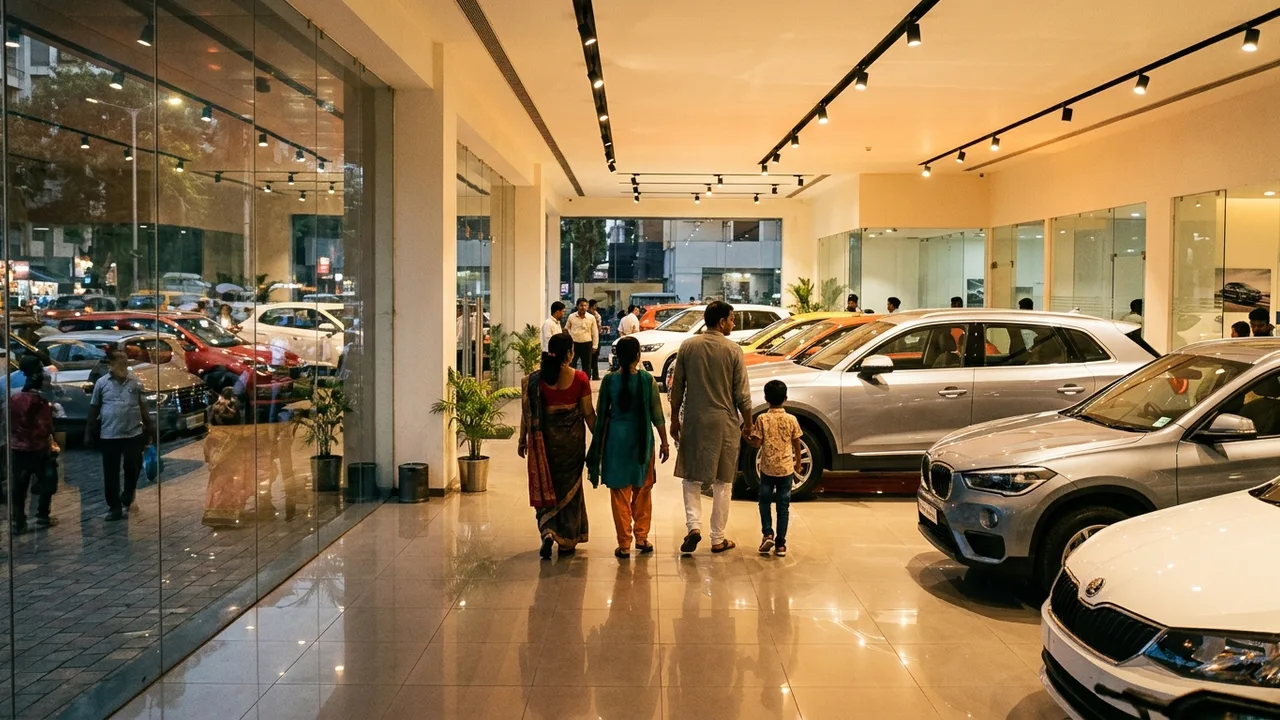
The immediate effect was dramatic. Manufacturers passed the savings through almost entirely, and did so on 22 September 2025 — days before the festive season.
Hyundai posted its strongest single-day sales in five years, with around 11,000 dealer billings. Maruti, Mahindra, Toyota, Mercedes-Benz and BMW all announced price cuts.
A year on, the effects that have persisted are these:
1. The entry-level market came back to life. The 18% slab reset the arithmetic for first-time buyers. Small cars in India had been shrinking as a share of the market for years, squeezed by SUV mania and rising prices. GST 2.0 stopped the bleeding.
2. The on-road price fell by more than the tax cut. This is the underrated part. Road tax, registration and insurance are all calculated as a percentage of the ex-showroom price. Lower the ex-showroom price and the on-road price falls by more than the GST saving alone. The multiplier effect is real.
3. The EV advantage widened. EVs stayed at 5%. Against 18% for a small car and 40% for an SUV, that gap is now enormous — and it is the single biggest reason India's EV market doubled in the year that followed. An electric SUV at 5% versus a petrol SUV at 40% is a 35-point tax preference. Nothing else in Indian EV policy comes close to that in its effect.
4. Compliance got simpler. All auto components now sit at a uniform 18% regardless of HS code classification, ending years of classification disputes between manufacturers and suppliers.
Where the winners and losers actually landed
Won:
- First-time buyers. The Swift, i10, Tiago, WagonR bracket is meaningfully more affordable.
- Luxury buyers. A ₹50 lakh car got several lakh cheaper. Corporate fleets and aspirational buyers returned.
- Farmers. Tractors fell to 5%, from higher slabs. This is quietly one of the most consequential rural-economy measures in years.
- Commuters. Motorcycles up to 350cc — the vast majority of Indian two-wheelers — fell from 28% to 18%.
- Logistics. Buses, trucks, three-wheelers and ambulances all fell to 18%.
Lost:
- Premium motorcycles. Above 350cc, the rate went from 28% to 40%. Superbikes got materially more expensive.
- Yachts and private aircraft. Up to 40%. Few tears.
The used-car complication
GST on used cars is charged on the dealer's margin, not the full sale price — a rule that has been in place since 2018.
Example: a dealer buys a three-year-old Brezza for ₹7 lakh and sells it for ₹7.8 lakh. The margin is ₹80,000. GST applies to that margin only.
If you buy from a private individual rather than a registered dealer, GST does not apply at all.
GST 2.0 did not directly change this. But it changed the used market indirectly, and in a way that hurt sellers: cheaper new cars pull used prices down. If a new Swift is ₹60,000 cheaper than it was, a two-year-old Swift has to be cheaper too. Anyone who bought a car in mid-2025 and sold it in mid-2026 absorbed that adjustment.
The honest assessment, one year on
GST 2.0 worked. It simplified a genuinely absurd system, cut effective taxes across almost the entire market, and delivered the savings to consumers rather than letting them be absorbed by manufacturers. That is a rare outcome for a tax reform anywhere.
The one criticism worth making is about the cliff. The distinction between an 18% car and a 40% car is drawn at 4,000mm of length and specific engine capacities. That is not a gentle gradient — it is a 22-point cliff edge.
The result is entirely predictable, and visible in every Indian showroom: manufacturers engineer cars to be 3,995mm long. The sub-four-metre compact SUV, already an Indian speciality created by the previous tax regime, is now more entrenched than ever.
India's tax code is, in a very literal sense, designing India's cars.
Key takeaways
- GST 2.0 took effect 22 September 2025, replacing the four-slab structure and abolishing the compensation cess
- Small cars: 28% (+cess) → 18%. Large cars/SUVs: ~48–50% effective → 40%
- EVs remain at 5% — a 35-point advantage over a petrol SUV
- On-road prices fell by more than the tax cut, because road tax and insurance scale with ex-showroom price
- The 4,000mm length cliff means Indian cars are still designed around the tax code
Sources & further reading
- 56th GST Council meeting notifications
- India Briefing
- ClearTax
- Bajaj Finserv
- Autocar India
- Economic Times
Figures, prices and policy details were current at the last-updated date above. Automotive pricing, incentives and regulations change frequently — verify time-sensitive details with the linked primary sources. Read our editorial policy and fact-checking standards.