📚 MOMENTS & MILESTONES.
The transition that made everything else possible
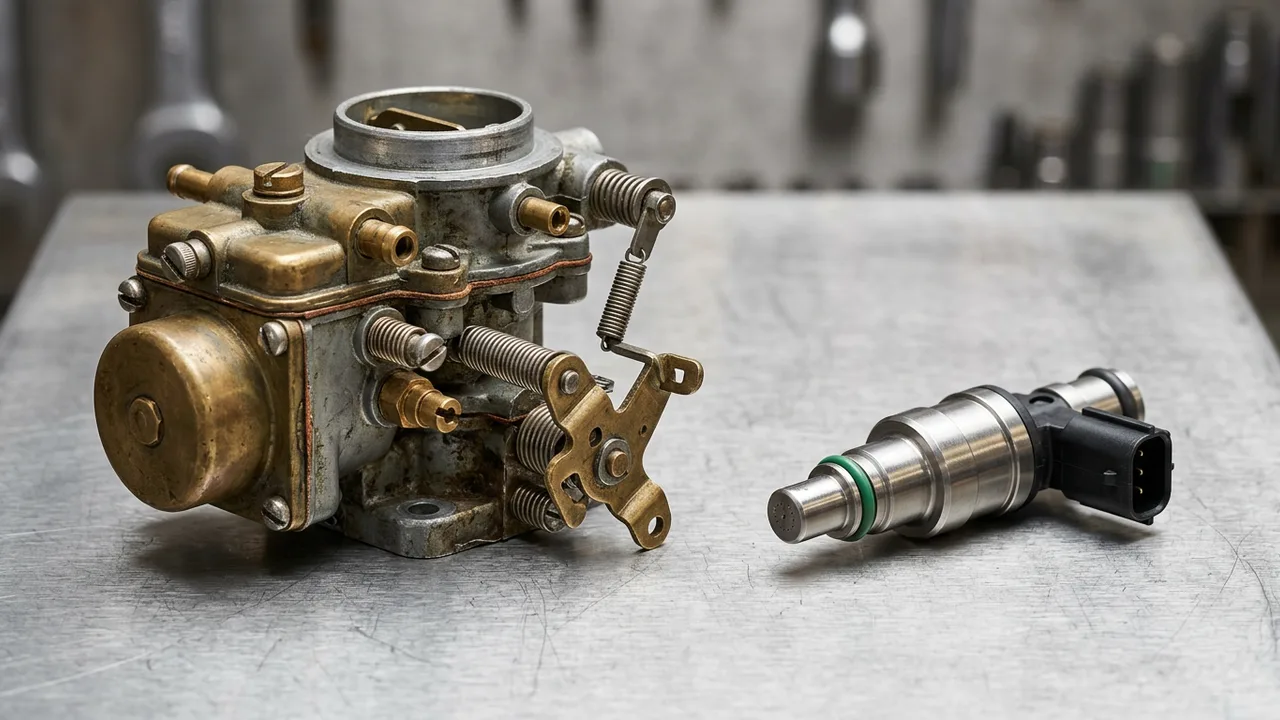
Carburettors metered fuel into engines for roughly a century, using a mechanical arrangement of venturis, jets and floats that was elegant, comprehensible and — crucially — repairable by anyone with basic tools.
Within roughly two decades they were essentially gone from passenger cars.
The reason wasn't performance, though fuel injection delivers it. It was emissions regulation — and understanding that explains a great deal about how modern cars came to be.
What a carburettor couldn't do
A carburettor meters fuel mechanically, responding to airflow through a venturi. It is fundamentally an approximation.
It cannot precisely control the air-fuel ratio across the full range of engine speeds, loads, temperatures and altitudes. It's tuned to be adequate across a range and optimal nowhere.
That imprecision was acceptable until emissions regulation arrived — and then it wasn't.
Because the catalytic converter changed everything.
The catalytic converter is the actual cause
This is the connection most accounts miss.
A three-way catalytic converter — which reduces the main regulated pollutants simultaneously — only works within a very narrow band around the stoichiometric air-fuel ratio.
Stray outside that band and the catalyst's efficiency collapses.
A carburettor cannot hold that precision. Fuel injection, with an oxygen sensor providing closed-loop feedback to an electronic control unit, can hold it continuously across every operating condition.
So the sequence is: emissions regulation → catalytic converters → the need for precise air-fuel ratio control → electronic fuel injection becomes not merely better but mandatory.
Performance and economy improvements were genuine and, in a sense, incidental.
What fuel injection delivered
1. Emissions compliance, which was the driver.
2. Better fuel economy — precise metering wastes less.
3. More power — better fuelling across the rev range, and the ability to run higher compression.
4. Reliable cold starting. Anyone who remembers manual chokes, flooding and coaxing a cold engine will recognise this as a substantial quality-of-life improvement.
5. Altitude compensation automatically, which carburettors required rejetting to approximate.
6. Consistency. No drift out of tune.
What was lost
An honest account needs this, and it connects to arguments our coverage makes repeatedly:
1. Repairability. As our Land Rover and Ambassador retrospectives both argued, the ability to fix a vehicle anywhere with basic tools is a genuine virtue. A carburettor could be stripped, cleaned and adjusted at the roadside. An ECU cannot.
2. Comprehensibility. A carburettor's operation is visible and mechanical. Fuel injection is a black box to most owners.
3. Serviceability without specialist equipment.
As our Corolla then-and-now analysis concluded, complexity is one of the two genuine regressions of modern motoring — and fuel injection is where that trade began in earnest.
It was worth it. The emissions and economy gains are enormous, and nobody sensibly wants carburettors back. But it's the origin point of the modern car's dependence on electronics — and, as our semiconductor piece explored, that dependence now runs very deep indeed.
The pattern this establishes
Fuel injection set a template that recurs throughout modern motoring:
Regulation drives technology adoption more powerfully than consumer demand. Buyers didn't demand fuel injection. Emissions rules made it necessary, and the consumer benefits followed.
The same pattern explains:
- Catalytic converters themselves
- ABS and stability control, which became standard through regulation
- Pedestrian impact requirements, which as our design piece explained dictate modern front-end shapes
- Automatic emergency braking, now standard largely through regulatory and rating pressure
- Electrification itself, driven substantially by emissions rules and mandates
Understanding fuel injection's history is understanding how the modern car actually gets made: regulation sets a requirement, engineering finds a solution, and the solution frequently turns out to be better in ways nobody demanded.
The bottom line
Carburettors ran cars for a century and disappeared in two decades — not because fuel injection was faster, but because catalytic converters need precise air-fuel control that a mechanical approximation cannot provide.
Emissions regulation was the cause. Performance and economy were consequences.
What was gained — compliance, economy, power, reliable cold starting, consistency — is enormous, and nobody wants carburettors back.
What was lost is repairability and comprehensibility, and as our archive retrospectives keep noting, those are genuine virtues that modern cars have progressively surrendered.
The lasting lesson is the pattern: regulation drives adoption more powerfully than demand, and the consumer benefits arrive afterwards. That's how ABS, stability control, pedestrian protection, AEB and electrification all happened too.
Key takeaways
- Carburettors ran cars for a century and vanished in two decades — and performance wasn't the reason
- The catalytic converter is the actual cause: it only works within a narrow band around the stoichiometric ratio, which a mechanical carburettor can't hold
- Fuel injection delivered compliance, economy, power, reliable cold starting and automatic altitude compensation
- What was lost was repairability and comprehensibility — the origin point of the modern car's deep electronic dependence
- The lasting pattern: regulation drives technology adoption more powerfully than consumer demand, and the benefits arrive afterwards
Sources & further reading
- Engine management and emissions control history
Figures, prices and policy details were current at the last-updated date above. Automotive pricing, incentives and regulations change frequently — verify time-sensitive details against the primary sources listed below. Read our editorial policy and fact-checking standards.