🗳️ OPINION
This is a column, not a news report. It takes a position on contested policy, and the strongest opposing case is set out below.
The argument
Britain's ZEV mandate — requiring manufacturers to sell an increasing proportion of zero-emission vehicles each year — is frequently attacked as unworkable, and frequently defended as essential.
My position is neither: it's working, and that's the problem.
The mandate is achieving precisely what it was designed to achieve — pushing manufacturers to sell more electric cars. What it wasn't designed to do, and doesn't do, is ensure that the conditions for people to own those cars actually exist.
The result is a policy optimising the wrong variable.
What the mandate does well
Credit where it's due, because the case for it is real:
1. It creates certainty for manufacturers. Investment in electrification requires knowing the direction of travel. A mandate provides that in a way exhortation doesn't.
2. It has genuinely accelerated model availability. Britain now has one of the widest ranges of affordable EVs anywhere — as our small-EV megatest found, the segment went from a handful of compromises to dozens of genuinely good options.
3. It pushed manufacturers past the compliance-car era. Cars like the Renault 5 exist partly because manufacturers needed volume, not tokens.
4. Emissions targets require something like it. "Let the market decide" is not a policy when the market's price signals don't include the externality.
Where it fails
The mandate regulates supply. It does almost nothing about demand — and demand is constrained by something the mandate can't touch: charging.
As our own testing has found repeatedly and from three different directions:
- Our public-charging diary found that living without a home charger substantially erodes the EV cost advantage and adds a time cost nobody anticipates
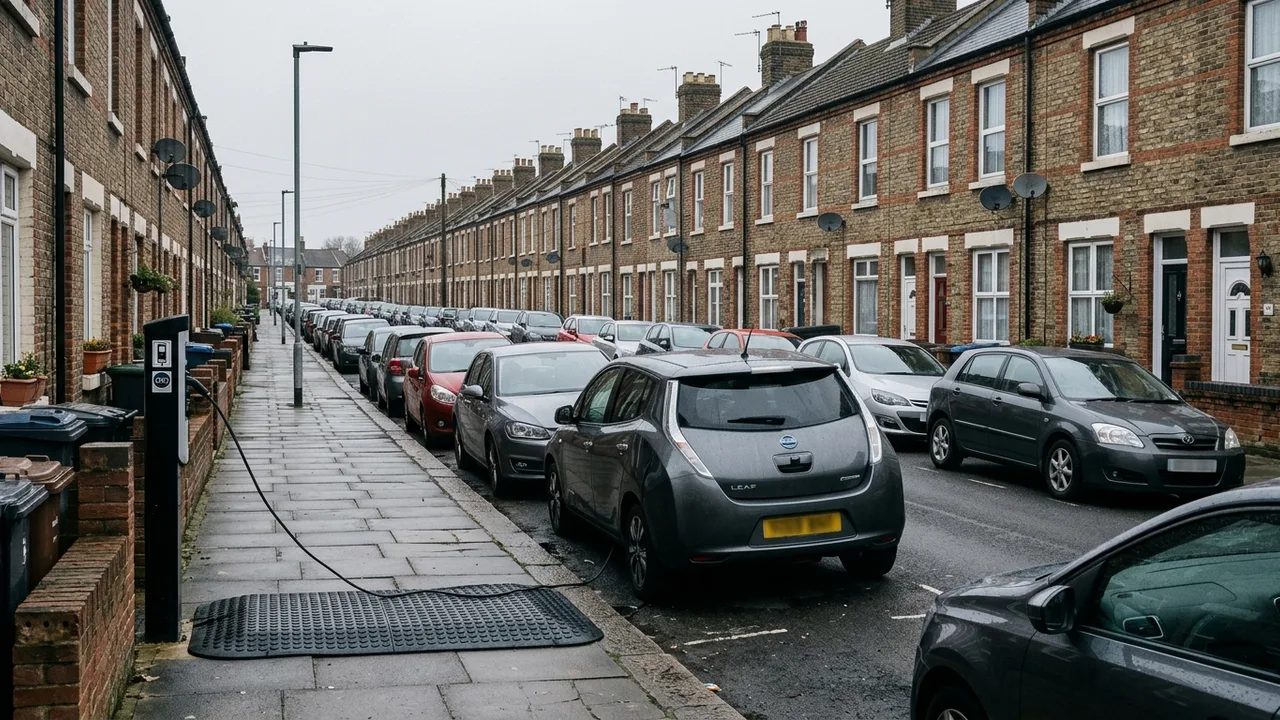
- Our apartment charging test in India found the decisive variable is whether you can charge where you park — and the same logic applies to British terraced streets and flats
- Our winter range testing found cold weather costs 20–30%, which matters far more when you can't top up at home overnight
Here is the uncomfortable consequence: the mandate pushes EVs toward everyone, while the economics of EV ownership currently favour people with driveways.
That's a policy creating a divide along housing type, which correlates with income, tenure and region. A homeowner with a driveway gets cheap overnight charging. A renter in a terraced street pays rapid-charging rates and spends the time.
Both are told to buy the same car.
The second failure: it measures the wrong thing
The mandate counts cars sold, not emissions avoided.
Those aren't the same, and the gap matters:
- An EV sold to someone who charges at home on a renewable tariff and drives 15,000 miles a year is a large emissions saving
- The same car sold to someone who rarely drives, or charges on a carbon-intensive grid mix, saves considerably less
- Meanwhile, as our hybrid testing found, a full hybrid delivering reliable real-world gains to a high-mileage driver without home charging may achieve more actual emissions reduction — and counts for nothing
A policy that counts units rather than outcomes will optimise for units. That's not a flaw in execution; it's a flaw in design.
The strongest counter-argument
Here's the best case against me, stated properly:
1. Perfect is the enemy of good. Charging infrastructure won't be built without EV volume to justify it. The mandate creates the demand that makes investment rational — you can't sequence infrastructure first.
2. Complexity is the enemy of enforcement. A mandate counting units is auditable. A mandate measuring lifetime emissions per vehicle would be gameable, contestable and slow.
3. The transition has to start somewhere. Waiting for equitable conditions means waiting indefinitely, and the emissions maths doesn't allow it.
4. Prices fall with volume. Early adopters — mostly those with driveways — subsidise the learning curve that eventually makes EVs cheap enough for everyone. As our depreciation piece found, that transfer is already visible in the used market.
These are genuinely strong arguments, and the fourth is the one I find hardest to dismiss.
What I'd actually change
Not abolition — that would be worse. But:
1. Tie the mandate to charging provision. Regional targets for public charging, with particular weight on on-street and residential provision for households without off-street parking. The supply-side push exists; the demand-side enabler doesn't.
2. Address the tariff gap. The difference between domestic and public charging rates is the single biggest inequity in EV ownership. It's a fixable policy problem, and largely untouched.
3. Give credit for outcomes, not just units. Even partial recognition of real-world emissions performance would improve incentive alignment.
4. Stop treating hybrids as failure. As our powertrain comparison concluded, for buyers who can't charge at home, a full hybrid is frequently the better answer. A policy framework that treats that as a dodge is ignoring its own users' circumstances.
The bottom line
The ZEV mandate is working, and the case for having something like it is strong. Manufacturer certainty, model availability and the end of the compliance-car era are real achievements.
But it regulates supply while demand is constrained by charging access — and it counts cars sold rather than emissions avoided.
The result is a transition that currently works best for people with driveways, which is a divide along housing type that policy created and policy could address.
Fix the charging side, and the mandate becomes a good policy. Leave it as it is, and it will keep achieving its stated goal while missing the point of it.
Key takeaways
- OPINION on contested policy. The strongest opposing case is set out in full above
- The mandate works — manufacturer certainty, model availability and the end of compliance cars are genuine achievements
- Its failure is that it regulates supply while demand is constrained by charging access, which the mandate doesn't touch
- The consequence is a divide along housing type: driveway owners get cheap overnight charging, renters pay rapid rates and the time cost
- It also counts cars sold rather than emissions avoided — and a full hybrid delivering real gains to a high-mileage driver without home charging counts for nothing
Sources & further reading
- UK ZEV mandate framework
- True Motion Auto public-charging diary, winter range testing and powertrain comparison. Opinion — clearly labelled. Verified July 2026.
Figures, prices and policy details were current at the last-updated date above. Automotive pricing, incentives and regulations change frequently — verify time-sensitive details against the primary sources listed below. Read our editorial policy and fact-checking standards.