The promise, and the honest scorecard
The core argument for auto tariffs was simple: make importing expensive enough, and manufacturers will build here instead — factories, jobs, supply chains, all coming home.
So, a year into the tariff era, did it work? The honest answer is "partly, slowly, and less than the headlines claim." Real reshoring is happening. But there's a large, important gap between what was announced and what's actually being built — and understanding that gap is the key to reading this whole story clearly.
Here's the scorecard, kept straight.
What's genuinely happening (the real column)
Real production shifts and investments are underway. Among the concrete moves:
- Hyundai opened a $7.6 billion plant in Bryan County, Georgia (2025), pushing its US car production past a million units a year, and announced a headline $21 billion US commitment through 2028
- Subaru moved Forester production from Japan to Indiana (2025)
- Rivian is building its R2 SUV in Normal, Illinois, with deliveries from spring 2026
- Nissan is moving Rogue production from Japan to Tennessee (2027)
- Mercedes announced $4 billion more for its Alabama plant, planning more core models there by 2027
- Toyota committed $10 billion across US plants over five years ($1bn near-term in Kentucky and Indiana)
- Honda shifted next-gen Civic Hybrid production from planned Mexico to Indiana (from May 2028, ~210,000/year)
- GM is reshoring next-gen Buick Envision from China to Kansas (from 2028) and Stellantis is reopening Belvidere, Illinois ($5bn US package)
That's not nothing. The broader data shows real momentum — US manufacturing construction elevated, the ISM Manufacturing PMI hitting a multi-year high (52.7 in March 2026), and tier-1 suppliers restructuring supply chains toward USMCA qualification. The reshoring impulse is genuine.
The gap: "announced" is not "built"
Here's where honesty matters, and where most coverage falls down.
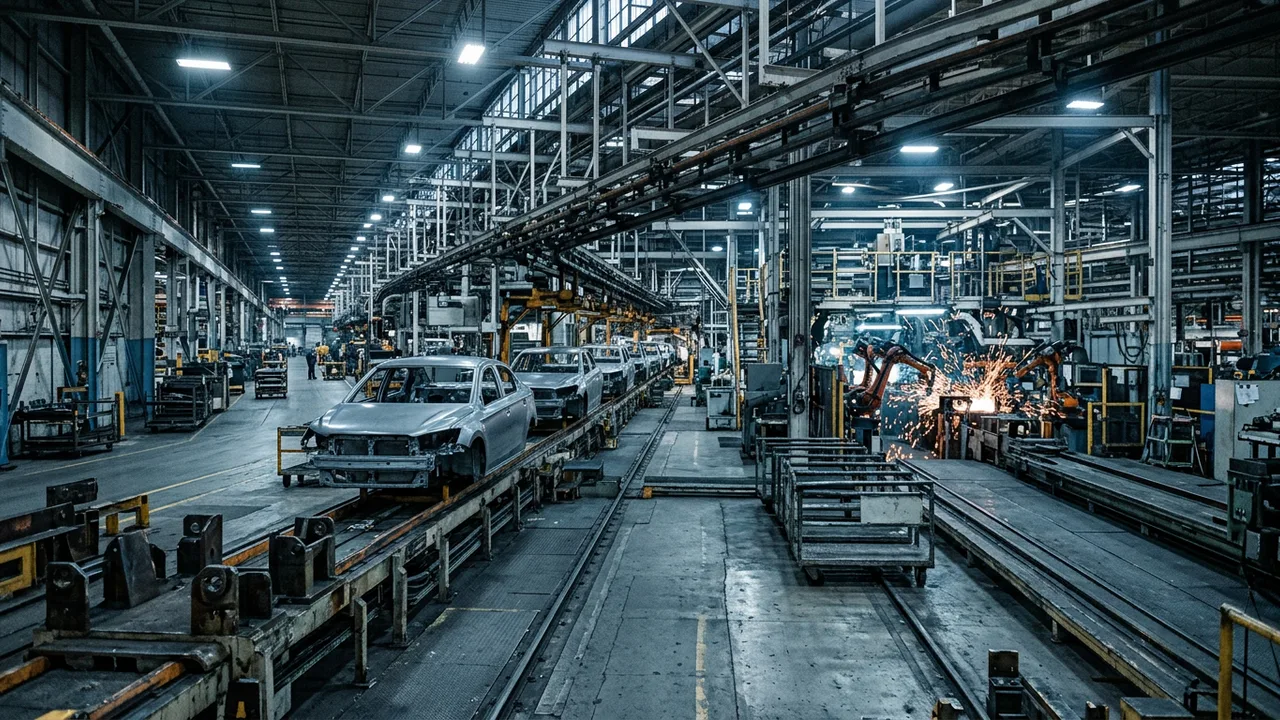
Most tariff-era "factory" announcements are reallocations of investment at existing plants, not brand-new plants being built. When fact-checkers examined the biggest claims, they found that — with rare exceptions — the announcements represented shifting production to existing facilities, not new ground-up construction. Building a genuinely new plant, or even meaningfully expanding an existing one, takes years — and many announcements may or may not fully materialise.
Three caveats deflate the headline numbers:
1. Timelines are long. Note the dates above: Honda's Civic shift is 2028, GM's Envision 2028, Nissan's Rogue 2027. These are multi-year moves. A tariff imposed in 2025 doesn't produce a car built in America until 2027–2028 at the earliest — and the tariff might change before the plant opens.
2. Much was already planned. Some "tariff-driven" investment was in the pipeline anyway. US auto-manufacturing construction was already rising under the previous administration (driven partly by IRA incentives). Attributing all of it to tariffs overstates the tariffs' role.
3. Reallocation isn't net new. Moving Forester or Rogue production from Japan to the US is a real shift — but it's relocating existing output, not necessarily adding net new capacity or the transformative job numbers implied.
The parts problem reshoring can't solve
Even where assembly reshores, a structural limit remains: the parts supply chain.
As we've covered throughout this section, a US assembly plant running on imported engines, transmissions and electronics still pays 25% on those parts. Reshoring final assembly reduces vehicle-tariff exposure; it doesn't eliminate parts-tariff exposure. And the parts supply chain is genuinely global and genuinely slow to relocate.
Notably, the biggest beneficiary of parts supply-chain shifts so far isn't the US — it's Mexico. USMCA-qualifying Mexican parts reach US assembly plants at 0% duty, making Mexico the default destination for new parts-capacity investment. So some of the "reshoring" is really "nearshoring" to Mexico — which serves USMCA compliance but isn't the "factories coming home to America" the tariffs promised.
The counter-forces pulling the other way
Reshoring isn't a one-way street. Several forces cut against it:
- EV demand softness led GM to lay off 1,300 workers at its Factory Zero EV plant — reshoring headlines coexist with EV-related cuts
- Losses from tariffs ate into the very budgets that fund new investment — VW, BMW and Mercedes reported ~$6 billion in combined tariff losses in 2025
- Policy uncertainty (the USMCA review, the Supreme Court ruling, shifting rates) makes multi-year capital commitments risky — you don't build a $7 billion plant for a tariff that might not exist in three years
- Cancelled projects (Honda/Sony's AFEELA EV venture, various delayed EV plans) show the churn cuts both ways
The verdict: real, but oversold
Put the columns side by side and a fair verdict emerges:
The tariffs are producing real reshoring — genuine plant investments, real production shifts from Asia to the US, real supply-chain restructuring. That's not spin; it's happening.
But it's slower, smaller, and more complicated than advertised. Much of the "new factory" rhetoric is reallocation at existing plants; timelines run to 2027–2028; some investment was already planned; the parts chain resists reshoring (and often nearshores to Mexico instead); and counter-forces (EV softness, tariff losses, policy uncertainty) blunt the momentum.
Reshoring is a decade-long structural process, not a switch a tariff flips. The factories that do come back take years to build and open into a market that may have moved on. The tariff can tilt long-term investment decisions toward the US — and it demonstrably has, at the margin. It cannot conjure factories quickly, and the gap between announcement and concrete-and-steel is where most of the political rhetoric lives.
What it means for you
As a car buyer: don't expect reshoring to lower prices soon. New domestic plants open in 2027–2028, and even then their imported parts carry tariffs. The near-term effect on sticker prices is upward (tariff costs), not downward (cheaper domestic production).
As someone reading the news: apply the "announced vs built" filter to every reshoring headline. Ask: is this a new plant, or a reallocation? When does it actually open? Was it already planned? The answers usually shrink the claim.
As a worker or community: the jobs are real but backloaded and uneven — some plants hiring, others (EV-related) cutting. The net picture is more mixed than either boosters or critics admit.
The bottom line
Will tariffs bring factories back? Some, eventually, partially. The reshoring is real but oversold — heavy on multi-year announcements and reallocations, lighter on ground-up plants opening now. The parts chain resists coming home (and often nearshores to Mexico instead), timelines stretch to 2028, and counter-forces blunt the momentum. Tariffs can tilt the long game toward domestic production, and at the margin they have. But a factory is concrete, steel and years — not something a border duty summons on command. Read every reshoring headline with the "announced vs built" filter, and the true scorecard comes into focus: progress, genuine but gradual, and a long way from the promise.
Key takeaways
- Real reshoring is happening — Hyundai (Georgia), Subaru (Indiana), Rivian (Illinois), Nissan, Mercedes, Toyota, Honda and GM all shifting production or investing
- But most "new factory" announcements are reallocations at existing plants, not ground-up builds, with timelines running to 2027–2028
- Some investment was already planned (pre-tariff), and reshoring can't escape the 25% parts tariff — which often nearshores to Mexico instead
- Counter-forces (EV demand softness, ~$6bn in 2025 tariff losses, policy uncertainty) blunt the momentum
- Verdict: real but oversold — reshoring is a decade-long process, not a switch a tariff flips; near-term price effect is upward, not downward
Sources & further reading
- C.H. Robinson freight market update
- PolitiFact
- IoT Analytics
- National Law Review (Foley Automotive Update)
- CalcMyTariff
- Newsweek
- Reuters. Verified July 2026.
Figures, prices and policy details were current at the last-updated date above. Automotive pricing, incentives and regulations change frequently — verify time-sensitive details with the linked primary sources. Read our editorial policy and fact-checking standards.