📚 MOMENTS & MILESTONES.
The shock
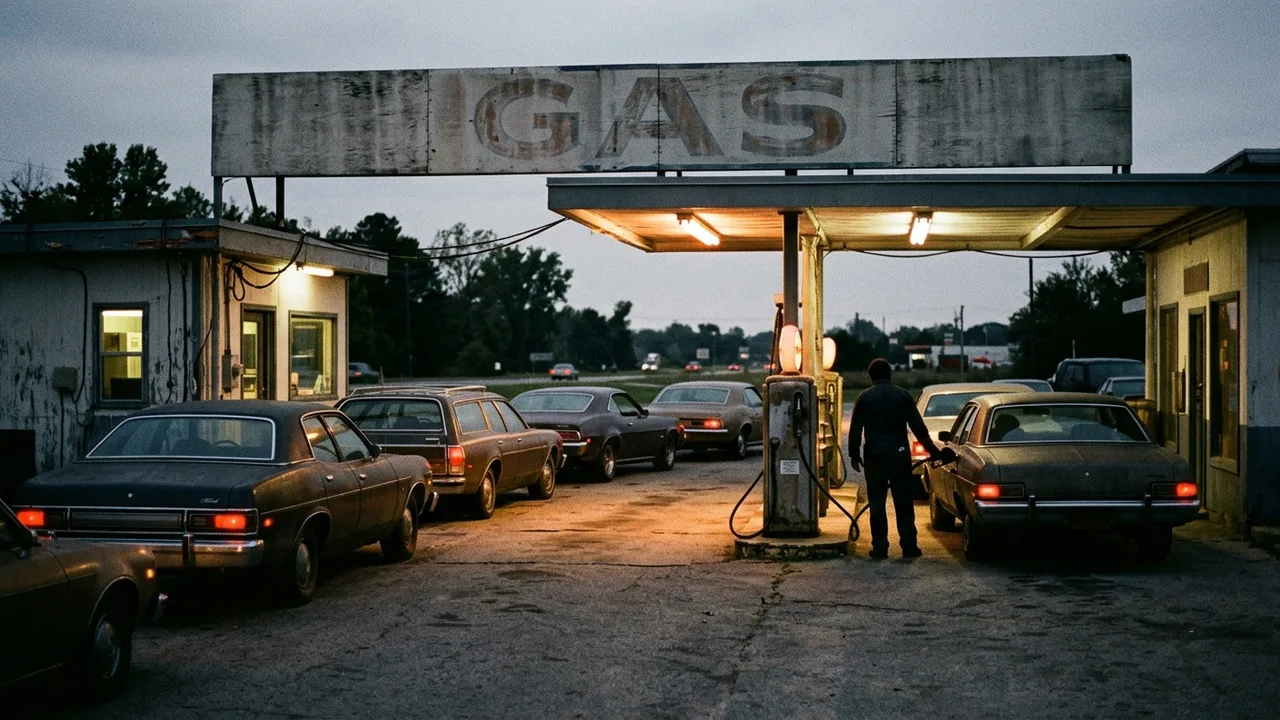
The 1973 oil crisis — an embargo that quadrupled crude prices and produced fuel shortages across Western markets — reshaped the car industry more comprehensively than any single event before or since.
Cars that had been rational became absurd overnight. Manufacturers whose entire product strategy assumed cheap fuel found themselves selling the wrong products, and the companies that adapted fastest gained advantages lasting decades.
What it killed
1. The American muscle car era ended.
Large-displacement V8 performance cars, already under pressure from emissions regulation and insurance costs, became commercially untenable.
As our Corvette chronology documented, the C3's power collapse across the 1970s is the clearest illustration in American motoring — the same nameplate, dramatically less powerful by the decade's end. Emissions rules and fuel prices did that together.
2. Large, thirsty cars generally lost their market rapidly.
3. Manufacturer complacency about efficiency. Fuel economy went from an afterthought to a purchase criterion.
What it created
1. ⭐ The Japanese opportunity — the most consequential outcome.
Japanese manufacturers were already building small, efficient, well-made cars — not because they had anticipated an oil crisis, but because Japan's domestic market, taxation and road conditions demanded them.
When Western buyers suddenly wanted exactly that, Toyota, Honda, Datsun/Nissan and others were ready.
As our Corolla chronology noted, the second and third generations expanded into North America during precisely this period: "the Corolla was in exactly the right place at the right time, and the reputation built here proved durable."
That reputation — efficient, reliable, sensible — was earned in the 1970s and is still commercially valuable fifty years later.
2. The modern small-car market in America. Before 1973, small cars were a niche. Afterwards they were a permanent segment.
3. Efficiency regulation. Fuel economy standards emerged in this period and have shaped product planning ever since — including, as our crossover-size opinion piece argued, footprint-based standards that now incentivise building bigger.
4. Diesel's European ascendancy accelerated, with consequences that ran for decades.
5. The first serious electric and alternative-fuel programmes, most of which failed — as our EV false-starts piece covers.
What it reveals about the industry
1. Product cycles are slower than shocks. A manufacturer cannot redesign a range in a year. The companies that benefited were those already building what the market suddenly wanted — which was luck as much as foresight.
2. Reputations formed in crises persist. Japanese manufacturers' efficiency and reliability reputation was earned in this period and still shapes purchase decisions. As our Kia history noted about brand perception, these things move slowly in both directions.
3. Regulation follows crisis. Efficiency standards, emissions rules and safety requirements have repeatedly emerged after shocks rather than before them.
4. Assumptions are the vulnerability. The American industry's assumption of permanently cheap fuel was reasonable given decades of evidence, and it was catastrophic when wrong.
The modern parallel — and the caution
It's tempting to draw a straight line to electrification, and worth doing carefully.
The similarity: an external shock (climate policy rather than fuel prices) is forcing product change faster than normal cycles allow, and manufacturers already positioned benefit disproportionately.
The important difference: the 1973 shock was sudden and unmistakable. The current transition is gradual, contested and politically variable — which makes positioning far harder.
And as our failed-predictions piece warned, the press has repeatedly got this wrong by assuming linear trends. Pure-electric pickup demand undershot forecasts. Ram cancelled its all-electric truck. GM's conventional-V8 hedge is looking well-judged.
The 1973 lesson isn't "the shock always comes." It's that manufacturers who can serve multiple scenarios survive shocks better than those betting on one — which is precisely what the hedged electrification strategies our truck coverage documents are attempting.
The bottom line
The 1973 oil crisis reshaped the industry more than any comparable event — ending the American muscle era, creating a permanent small-car market, and above all handing Japanese manufacturers an opportunity they were already positioned to take.
That positioning was substantially luck. Japan built small efficient cars because its domestic conditions demanded them, not because anyone forecast an embargo. But the reputation they earned in that window is still commercially valuable half a century later.
The lasting lesson is about assumptions. The American industry's belief in permanently cheap fuel was reasonable and catastrophic.
And the applicable lesson for now is not that a shock is coming, but that flexibility beats conviction — which is why the hedged strategies our current coverage documents look increasingly sensible.
Key takeaways
- The 1973 embargo reshaped the industry more comprehensively than any comparable event, ending the American muscle era
- Our Corvette chronology shows it clearly: the C3's power collapse across the 1970s, from emissions rules and fuel prices together
- The Japanese opportunity was the most consequential outcome — they already built small efficient cars, and Western buyers suddenly wanted exactly that
- That reputation, earned in the 1970s, is still commercially valuable fifty years later — reputations formed in crises persist
- The applicable lesson isn't that a shock is coming, but that flexibility beats conviction — which is why hedged electrification strategies look sensible
Sources & further reading
- Oil crisis and automotive industry history
Figures, prices and policy details were current at the last-updated date above. Automotive pricing, incentives and regulations change frequently — verify time-sensitive details against the primary sources listed below. Read our editorial policy and fact-checking standards.