📚 INDUSTRY HISTORY. The causes of British industrial decline remain genuinely contested among historians and economists. This presents the main explanations fairly rather than asserting one.
The scale of what was lost
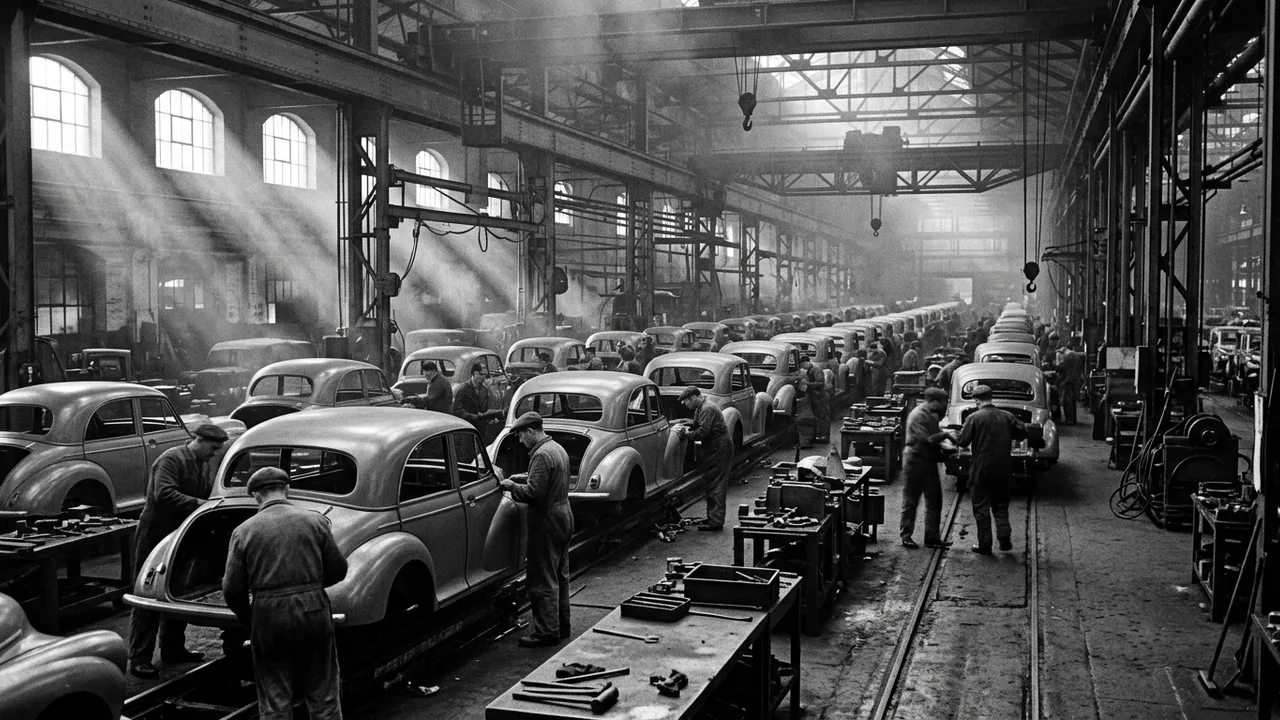
Britain was, for a period after the Second World War, the world's largest car exporter.
That fact is easy to state and difficult to grasp from the present. The industry encompassed Austin, Morris, Rover, Triumph, Standard, Riley, Wolseley, Hillman, Humber, Singer, Sunbeam, Jaguar, MG, Jensen and dozens more — a genuinely enormous industrial base.
Almost none survive as British-owned volume manufacturers.
But the decline story is incomplete, and the second half of this piece explains why.
What happened — the contested explanations
Historians disagree about the relative weight of these, and anyone asserting a single cause is oversimplifying.
1. Fragmentation and failed consolidation. Britain had too many manufacturers producing too many overlapping models at insufficient scale. The consolidation into British Leyland (1968) was intended to address this and is widely judged to have been executed poorly — combining weak companies without rationalising products or plants.
2. Industrial relations. Strikes and disputes disrupted production severely through the 1960s and 70s. How much weight this deserves is genuinely contested — some accounts treat it as the primary cause, others as a symptom of poor management and underinvestment.
3. Underinvestment. Insufficient capital spending on plant, tooling and product development relative to German and Japanese competitors. This compounds with everything else.
4. Product and quality problems. As our Jaguar history described, British cars of the period were frequently capable and unreliable — a reputation that persisted long after the underlying problems were addressed.
5. Competition. German and then Japanese manufacturers offered better-built, more reliable, better-value products. Buyers responded rationally.
6. Management and strategy. Poor model planning, weak brand management and strategic confusion.
7. Currency and macroeconomic factors, which affected export competitiveness.
The honest position is that these interacted, and attributing the collapse to any single cause — particularly the politically convenient ones — misrepresents a complicated history.
The nationalisation era
British Leyland was taken into state ownership in 1975 as the crisis deepened, and the subsequent period involved substantial public investment, repeated restructuring and continued decline.
The Rover Group emerged from this, was sold to British Aerospace, then to BMW (1994), then broken up — with BMW retaining Mini (as our Mini history covered, a decision that looks increasingly astute) and Land Rover going to Ford, while MG Rover continued independently until its collapse in 2005.
That collapse marked the effective end of British-owned volume car manufacturing.
What actually replaced it — and this is the part the decline story misses
Here's the crucial correction: as our badge-versus-factory investigation established, Britain still builds a great many cars.
Manufacturing is substantially British:
- Nissan Sunderland — one of Britain's largest car plants
- Toyota Burnaston and the Deeside engine plant
- BMW Oxford, where Mini is built
- JLR's Solihull, Halewood and Wolverhampton operations
- Bentley Crewe, Rolls-Royce Goodwood, McLaren Woking, Aston Martin Gaydon and St Athan
As that investigation concluded: a Nissan built in Sunderland is, in manufacturing terms, more British than a Jaguar-badged car built abroad.
Ownership went abroad. Manufacturing substantially didn't.
The genuine British strength nobody counts
The most under-appreciated part of the story is engineering.
Britain's motorsport and specialist engineering cluster — particularly the "Motorsport Valley" corridor — is world-leading. Formula One teams, engineering consultancies and design houses based in Britain work on vehicles for manufacturers worldwide.
A car designed in Britain, built in Europe, wearing a Japanese badge is not unusual. That value doesn't appear in any national production figure, and no badge reflects it.
Low-volume specialist manufacturing — McLaren, Aston Martin, Morgan, Caterham, Ariel and others — is a genuine British capability, and the boutique-builder framing understates how technically sophisticated it is.
What it means now
In the tariff era, this matters commercially. As our trade coverage established:
The UK–US Economic Prosperity Deal gives UK-built cars a 10% US tariff within a 100,000-vehicle annual quota — the best rate of any major exporter, though JLR alone nearly fills it, with 27.5% above.
India–UK CETA gives qualifying UK-origin vehicles progressively reduced Indian duties, with rules of origin requiring genuine UK manufacture.
Both are written around where cars are built, not who owns the badge — which means Britain's actual manufacturing base, foreign-owned as it largely is, is the thing with commercial value.
The bottom line
Britain went from the world's largest car exporter to having almost no British-owned volume manufacturers, and the causes — fragmentation, failed consolidation, industrial relations, underinvestment, quality problems and competition — interacted in ways historians still contest.
But "boutique builder" undersells what remains.
Britain still builds a lot of cars — at Sunderland, Burnaston, Oxford, Solihull and elsewhere — and those are British jobs producing British value, whatever the badge says.
And the genuine strength is engineering. The motorsport and design cluster works on vehicles worldwide, and that capability appears in no production statistic.
The honest summary: Britain lost its car companies and largely kept its car industry. Those are different things, and conflating them produces a decline narrative that's more dramatic than accurate.
Key takeaways
- Britain was the world's largest car exporter and now has almost no British-owned volume manufacturers
- The causes are genuinely contested — fragmentation, failed consolidation, industrial relations, underinvestment, quality and competition interacted, and single-cause accounts oversimplify
- "Boutique builder" undersells what remains: Nissan Sunderland, Toyota Burnaston, BMW Oxford, JLR's plants, Bentley, Rolls-Royce, McLaren and Aston Martin
- The most under-appreciated strength is engineering — Britain's motorsport and design cluster works on vehicles worldwide, appearing in no production statistic
- In the tariff era, build location is what carries commercial value — the UK–US quota and India CETA rules are written around manufacture, not ownership
Sources & further reading
- British motor industry history
- SMMT
Figures, prices and policy details were current at the last-updated date above. Automotive pricing, incentives and regulations change frequently — verify time-sensitive details with the linked primary sources. Read our editorial policy and fact-checking standards.