📚 BRAND HISTORY.
The most successful automotive partnership in history
Maruti Suzuki's position in India has few parallels anywhere.
For decades it has held a share of a large, growing, fiercely competitive market that would be extraordinary in any country — and it did so from a starting point that looked, at the time, distinctly unpromising.
The 1983 deal that created it is arguably the single most consequential event in Indian automotive history, and it's worth understanding why it worked when so many similar arrangements didn't.
The unpromising beginning
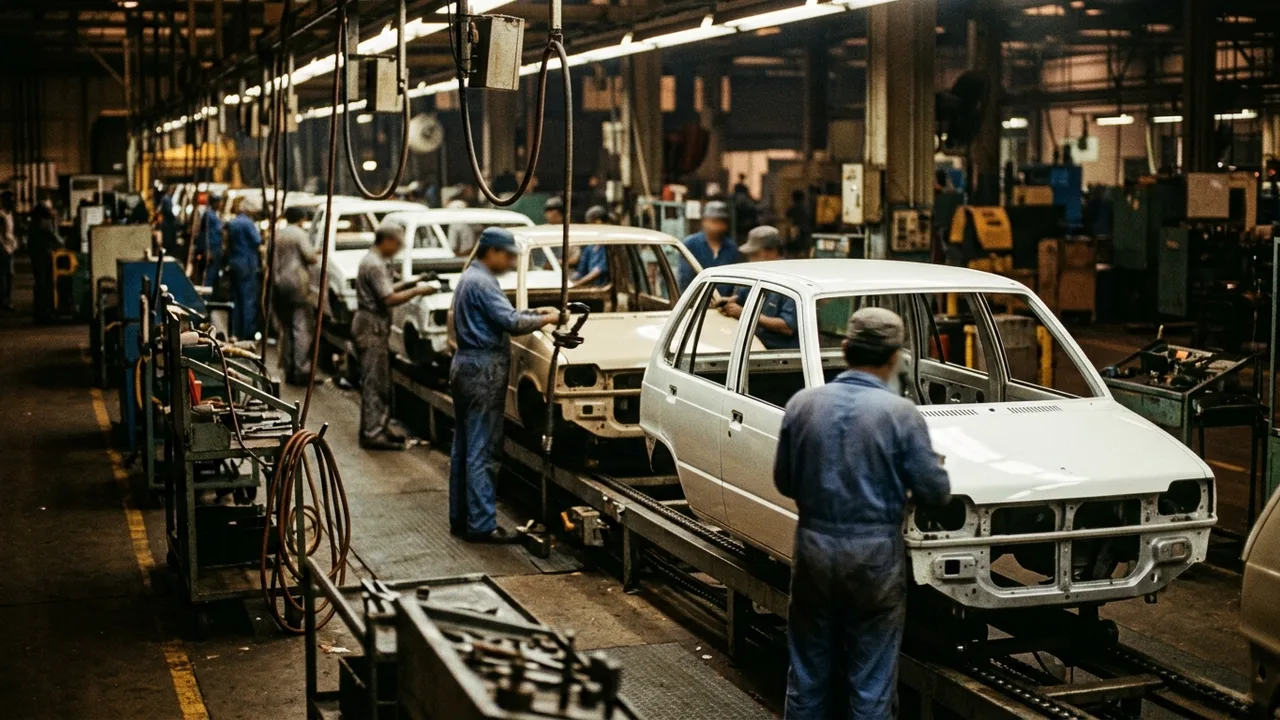
Maruti Udyog was established as a state enterprise with a mandate to produce an affordable "people's car" — a politically-driven project in a closed, protected economy.
The partner chosen was Suzuki — not Toyota, not Honda, not Nissan, but Japan's smallest major manufacturer, a specialist in small cars and motorcycles.
On paper this looked modest. A state-owned Indian enterprise with no passenger car experience partnering with Japan's smallest carmaker, in a market frozen since the 1950s.
It became the most dominant position in any major car market.
Why Suzuki was exactly right
This is the crucial insight, and it's counterintuitive.
Suzuki's speciality was small cars — precisely what India needed. A partner specialising in large or luxury vehicles would have brought expertise India couldn't use.
Suzuki was small enough to commit fully. For Toyota, India would have been one market among many. For Suzuki, India became existential — and that alignment of interest shaped everything that followed.
Suzuki brought manufacturing discipline, not just a design. As our Maruti 800 retrospective noted, the partnership imported Japanese quality control, supplier development and production standards into the Indian supply chain — with effects far beyond one car.
What they built
The 800 (1983) put India on wheels, as our retrospective described — arriving into a market of Ambassadors and Padminis with years-long waiting lists, and offering something generationally different.
But the product was only half of it. The genuinely decisive investment was elsewhere:
⭐ The service network.
This is the real story of Maruti's dominance, and it's the thing our comparisons cite constantly. Maruti built the largest service network in India by a substantial margin — reaching towns and regions competitors didn't serve, with parts availability and affordable repair costs.
In a country where a car is a major household investment kept for a decade or more, service reach is not a convenience — it's the product.
As our modern coverage repeatedly finds, this remains decisive: 1,500+ EV-ready service touchpoints made the e Vitara our winner in the India EV comparison, ahead of cars with arguably better individual specifications.
The supplier ecosystem. Maruti developed Indian component suppliers to Japanese standards, creating an industrial base that benefited the entire market — including competitors.
Resale value. Strong service and parts availability produce strong residuals, which as our comparisons note is real money over an ownership cycle and a genuine reason to buy.
The evolution
Privatisation. Suzuki's stake increased over time, and the company transitioned from state enterprise to Suzuki subsidiary — Maruti Suzuki.
Range expansion from the 800 through the Alto, Swift, Baleno, Ertiga, Brezza, Grand Vitara and beyond, covering nearly every mainstream segment.
The hybrid bet. As our comparisons found, the Grand Vitara's strong hybrid leads its segment on efficiency — a Toyota-derived technology arriving via the Suzuki-Toyota partnership.
Electrification. The e Vitara on the born-electric Heartect-e platform, which our review scored 8.5/10 and our comparison placed first — substantially on the strength of the service network the 800 built four decades earlier.
The challenges now
Maruti's dominance is genuinely being tested, and it's worth being clear about how:
1. Safety. Historically the segment's weakness. Tata's 5-star Punch took the best-selling title on the strength of crash protection at an accessible price — and as our micro-SUV comparison argued, that pressure is welcome and overdue.
2. SUV positioning. Maruti's small-car strength was less useful as India moved to SUVs, and rivals moved faster initially.
3. Electrification. The e Vitara is strong, but Tata leads on EV experience and the entry-level electric position is genuinely contested for the first time in forty years.
4. Premium aspiration. As our Bollywood and Honda City pieces traced, aspiration moved — and Maruti's value positioning doesn't capture it.
What the story reveals
1. The partner choice mattered more than the partner's size. Suzuki's small-car specialism and existential commitment beat larger companies' resources.
2. Distribution beat product. The 800 was a competent small Suzuki. The service network was the moat, and it's why competitors with better individual cars still struggle.
3. Industrial development compounds. The supplier ecosystem Maruti built benefited everyone — including its rivals — and made the Indian industry possible.
4. Dominance invites disruption. Tata's safety leadership attacked precisely where Maruti was weakest.
The bottom line
The 1983 Maruti-Suzuki deal built the most dominant position in any large car market, from a starting point of a state enterprise partnering with Japan's smallest major manufacturer.
It worked because Suzuki's small-car specialism matched what India needed, because the partnership was existential for Suzuki rather than peripheral, and — above all — because Maruti built a service network rather than just a car.
That network is still the decisive advantage. Our own comparisons keep concluding it: 1,500+ EV-ready service points made the e Vitara our winner over rivals with arguably better specifications, forty-three years after the deal was signed.
The dominance is now genuinely contested — by Tata on safety and EVs, and by a market whose aspirations have moved. That's healthy. But the moat Maruti dug in the 1980s is still the deepest in Indian motoring.
Key takeaways
- A state enterprise partnering with Japan's smallest major manufacturer built the most dominant position in any large car market
- Suzuki was exactly right: small-car specialism matched India's need, and the partnership was existential for Suzuki rather than peripheral
- The service network was the moat, not the car — the largest in India, reaching towns competitors didn't serve
- That advantage still decides outcomes: 1,500+ EV-ready points made the e Vitara our India EV comparison winner forty-three years later
- Dominance is now genuinely contested — Tata's 5-star Punch attacked exactly where Maruti was weakest, and that pressure is overdue
Sources & further reading
- Maruti Suzuki corporate history
Figures, prices and policy details were current at the last-updated date above. Automotive pricing, incentives and regulations change frequently — verify time-sensitive details against the primary sources listed below. Read our editorial policy and fact-checking standards.