📚 BRAND HISTORY. Tesla is a politically and commercially contested subject. This is a factual corporate history, not an assessment of its leadership or a position on the controversies surrounding it.
The company that moved an industry
Whatever your view of Tesla — and views are unusually strong — one thing is difficult to dispute: it forced the established industry to take electric vehicles seriously, considerably earlier than it otherwise would have.
That's the historically significant fact, and it's worth separating from the many other arguments the company attracts.
This is a corporate history. We're not litigating the controversies here.
The founding and early survival
Founded in 2003, with early funding and leadership changes that remain a subject of dispute among the parties involved.
The Roadster (2008) was the first product — an electric sports car based on a Lotus Elise platform. Expensive, low-volume, and produced in small numbers.
Its purpose was demonstrative rather than commercial. It proved an electric car could be genuinely fast and desirable rather than a compliance appliance — which, in an era when EVs meant milk floats, was a substantial argument.
Near-death. The company came close to failure during the 2008 financial crisis, a fact that's easy to forget given what followed.
The Model S and the turn
The Model S (2012) is the pivotal product.
It was the first electric car that competed on its own merits rather than on environmental credentials — genuinely fast, genuinely spacious, with a range that made it usable and a technology proposition that felt a generation ahead.
Critically, it established two things that still matter:
1. Over-the-air software updates. The idea that a car improves after purchase was genuinely novel and is now industry-standard — and, as our re-testing policy notes, it also means a car can get worse after purchase, which is a consequence the industry is still working through.
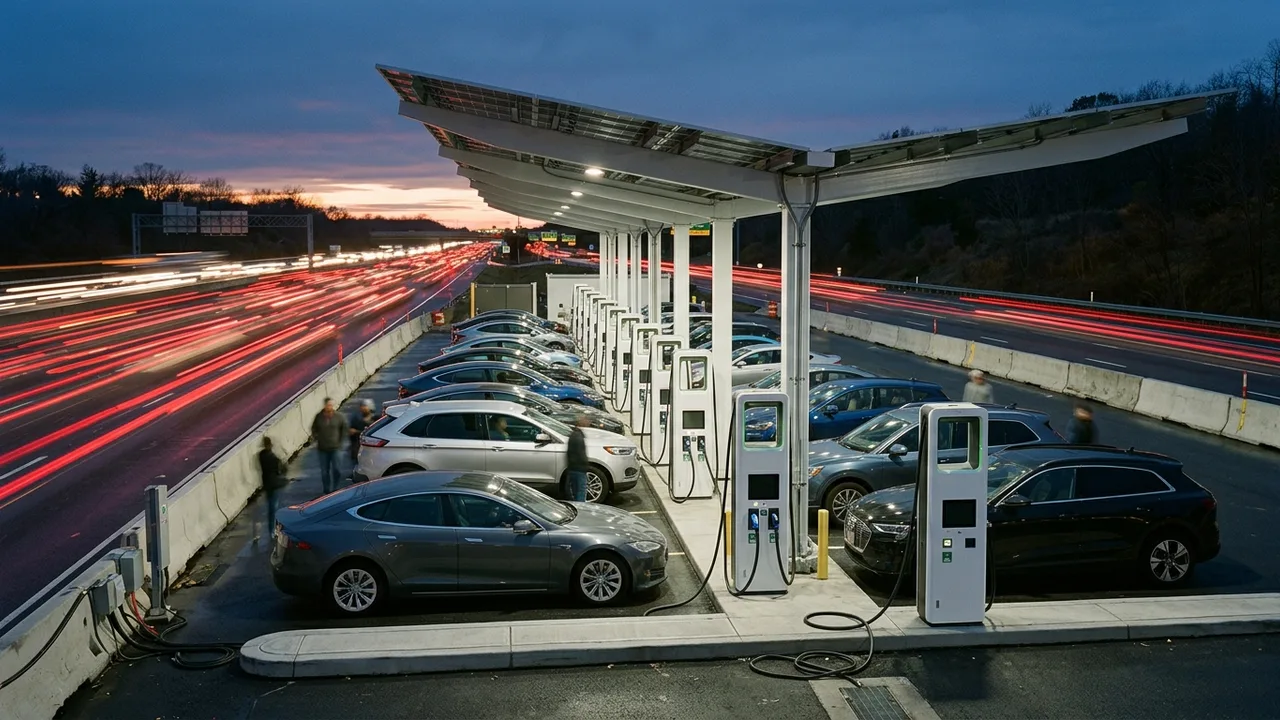
2. The Supercharger network. This may be the more consequential decision.
Building proprietary charging infrastructure was expensive, unproven and strategically risky. It also solved the chicken-and-egg problem that — as our hydrogen analysis explained — hydrogen never escaped.
Our analysis keeps returning to it: across the $45K electric SUV comparison, the £40K saloon comparison and our long-term ownership work, fast, reliable charging repeatedly proved worth more than the last 30 miles of range.
Scale
Model X (2015), Model 3 (2017) and Model Y (2020) took the company from niche manufacturer to volume producer.
The Model 3 and Y are the commercially decisive products — the Model Y in particular became the best-selling EV in the world, and as our comparison found, it keeps winning on ecosystem completeness rather than product superiority.
Manufacturing scale-up was genuinely difficult, with well-documented production problems, and the company's survival through that period was not assured at the time.
The current position
Tesla's position has changed materially, and our own coverage documents it directly:
Competition has closed the gap. As our comparisons found, rivals now match or beat the Model Y on many individual metrics. Our $45K SUV comparison placed it first on ecosystem rather than product, and noted that an AWD Chevrolet Equinox EV undercuts an AWD Model Y by over $10,000 with near-identical range.
Market share is declining even as the overall EV market grows — the Model Y remains the best-seller by a wide margin, but the trend is downward.
⭐ The Supercharger advantage has been commoditised. This is the most significant strategic development, and our NACS coverage traced it: native NACS ports now appear on the Chevrolet Bolt, Toyota bZ, Hyundai Ioniq 9, Porsche Cayenne Electric, BMW i3, Rivian R2 and Scout Traveler.
If every EV can use the best network, one of Tesla's central advantages is no longer exclusive — and our coast-to-coast road trip feature is explicitly designed to test what that means.
The company is also unusually exposed to non-product factors — leadership controversy, political association and brand perception — in ways that are genuinely difficult to separate from commercial performance. We're not going to pretend to quantify that.
What the history reveals
1. Demonstration mattered before scale. The Roadster sold in tiny numbers and proved a point that changed an industry's assumptions.
2. Infrastructure was the decisive bet. Building the Supercharger network solved a problem competitors ignored for years — and as our hydrogen piece argued, the chicken-and-egg problem is what kills alternative fuels.
3. Software-first was genuinely novel, and is now universal.
4. Being early creates advantages that erode. As our Lexus retrospective found about brand standing, advantages built over years can be matched — and NACS adoption commoditised Tesla's most durable one in remarkably little time.
5. Forcing an industry to move is a real achievement, separate from commercial outcomes. The established manufacturers' current electric ranges exist substantially because Tesla demonstrated the market.
The bottom line
Tesla's historically significant achievement is that it forced an industry to move — proving with the Roadster that electric could be desirable, with the Model S that it could compete on merit, and with the Supercharger network that infrastructure was solvable.
Its central strategic advantage has now been commoditised. NACS adoption means the charging network that decided so many of our own comparisons is available to almost everyone — and our coast-to-coast feature exists to test what that changes.
Competition has genuinely closed the product gap, as our comparisons repeatedly find, and the company faces commercial and reputational pressures that are difficult to separate from one another.
None of that diminishes the historical point. The current generation of electric cars from established manufacturers — including several we've rated highly — exists substantially because one company demonstrated the market before they believed in it.
Key takeaways
- This is a corporate history, not an assessment of the controversies surrounding the company or its leadership
- The Roadster (2008) was demonstrative rather than commercial — it proved an EV could be desirable rather than a compliance appliance
- The Model S (2012) established two things now universal: over-the-air updates and, more consequentially, the Supercharger network
- The Supercharger advantage has been commoditised — native NACS now appears on the Bolt, bZ, Ioniq 9, Cayenne Electric, BMW i3, R2 and Scout
- The historical achievement stands regardless: the established industry's electric ranges exist substantially because Tesla demonstrated the market first
Sources & further reading
- Tesla corporate history
- True Motion Auto EV comparisons, NACS coverage and long-term testing. Contested subject — verify facts and maintain factual framing. Verified July 2026.
Figures, prices and policy details were current at the last-updated date above. Automotive pricing, incentives and regulations change frequently — verify time-sensitive details against the primary sources listed below. Read our editorial policy and fact-checking standards.